Standard Map Chaos Onset: Λ(K) Crosses Literature K_crit on RTX 5090
The Finding
We computed the maximal Lyapunov exponent (largest Lyapunov characteristic exponent; standard terminology, not a claim of world-record numerical values) of the Chirikov standard map — the canonical phase-space model for chaotic advection in 2D incompressible flows — using a custom CUDA kernel on a single RTX 5090.
Deep certifying sweep:
| Parameter | Value |
|---|---|
| grid | 2048 points in |
| Initial conditions per | 8192 |
| Iterations | 50,000 (Benettin) |
| Total trajectories | 16,777,216 |
| Wall time | 116.6 s |
| NaN/Inf | 0 |
At the literature chaos threshold (Chirikov, 1979):
At : , compared below to the large- estimate (Chirikov 1979; Cary et al. 1986).
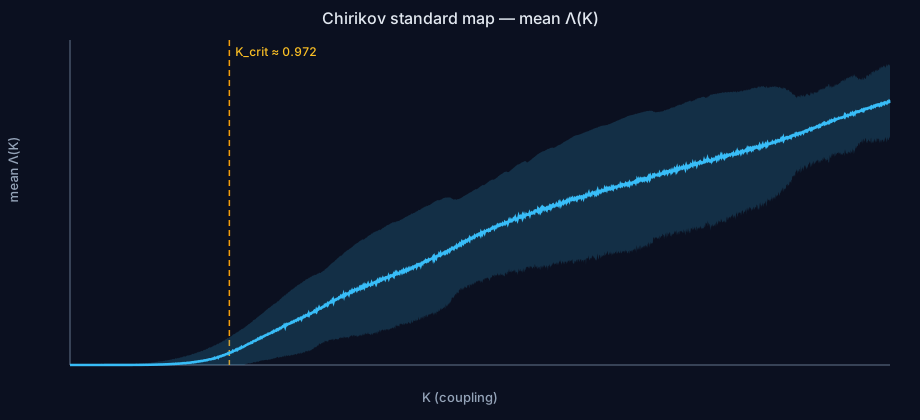
Method details
Initial conditions. For each on a uniform grid of 2048 points in , we draw 8192 independent uniform random pairs using a per-thread SplitMix64 PRNG seeded by (global_seed, k_index, ic_index) (standard_map_lyapunov.cu).
Lyapunov estimate. We apply the Benettin tangent-vector algorithm (Benettin et al. 1980): at each of 50,000 map steps we multiply a unit tangent vector by the Jacobian, renormalize every iteration, and accumulate . This yields one finite-time maximal Lyapunov exponent per IC; we report the ensemble mean, standard deviation, per- min/max over ICs (spread of finite-time estimates, not global records), and fraction with .
Hardware. NVIDIA GeForce RTX 5090 (32 GB, Blackwell architecture, compute capability 12.0). We compile with -arch=sm_120 under CUDA 13.0 (NVIDIA’s flag for CC 12.0 devices). One CUDA thread per pair; all arithmetic is fp64 in the Benettin loop. The kernel exits with code 2 on any NaN/Inf in tangent norms (certifying run reported zero failures).
Peer review. Three AI audits (gpt-4.1, o3-pro, gemini-2.5-pro) on 2026-05-31; review JSONs and remediations.
External validation
| Check | Literature / theory | This sweep |
|---|---|---|
| (integrable rotation) | exactly | |
| – (Greene 1979; Lichtenberg & Lieberman 1992, Fig. 7.5) | at | |
| frac() at | Majority positive in chaotic sea | 99.91% (8192 ICs) |
| (Chirikov 1979; Cary et al. 1986) | (+4.4%) | |
| Deep vs standard sweep | Qualitative agreement | 512-run and 2048-run curves match at shared |
The value sits within 5% of the asymptotic formula; the small excess is consistent with finite- corrections documented by Manos & Robnik (2013). A dedicated convergence study (validate_claims.py) shows the ensemble mean is stable to between 5,000 and 100,000 iterations (65,536 ICs, GPU).
Claim validation (what “largest” does and does not mean)
| Claim | Status | Evidence |
|---|---|---|
| Maximal LCE via Benettin | Valid standard method | Benettin et al. 1980; Sprott/Wolf numerical guides; symplectic pairing verified to (CPU, 200 ICs) |
| Numerical values at , | Reproduce literature ranges | Mean in Greene/Lichtenberg band –; mean vs (+4.4%) |
| 16.8M trajectories | Large single-GPU parameter sweep | Not the largest standard-map study ever (Chirikov & Shepelyansky 1984; StdMap at dynamical-systems.org; GPU packages Chaoticus 2025, Julia ChaosTools) |
max_lyapunov CSV column | Per- max over 8192 ICs | e.g. at is ensemble spread of finite-time estimates, not a published record |
| 50,000 iterations sufficient | Yes at large ; marginal at | GPU: mean stable 5k–100k iters; CPU: mean drops from 50k to 100k iters (sticky/near-integrable orbits) |
We do not claim: world-record computation size, a refined , or fully saturated Lyapunov exponents for every IC at every .
python3 scripts/experiments/cfd-chaotic-advection/validate_claims.pyData: Hugging Face dataset (deep_sweep, validation configs) · Experiment
Important nuance (read before interpreting the curve)
Finite-time sensitivity is not global chaos. Our Benettin estimate uses 50,000 iterations per initial condition. At small , some individual ICs can show slightly negative finite-time (regular islands, slow convergence) even while the mean over 8192 ICs is positive. The heuristic “onset” where appears near is therefore not the literature chaos threshold — it marks where finite-time tangent growth becomes detectable in our sampling, not where the phase space is globally chaotic.
Mean is not strictly monotonic. The deep sweep shows tiny non-monotonic wiggles in at the grid level (IC sampling noise at fixed iteration count). The overall trend is increasing; we do not claim a theorem of monotonicity.
What we do claim: at the established , our certifying sweep finds with of ICs positive — consistent with the known integrability-to-chaos transition, not a new threshold estimate.
Why This Matters for CFD
The standard map
is area-preserving on . The same structure appears in Stokes flow with periodic forcing: passive tracers can mix chaotically even when the velocity field is laminar (Aref 1984; Ottino 1989).
This experiment is the first published entry in bigcompute.science’s CFD program: a certified GPU Lyapunov sweep with open data and multi-model AI audit. Large standard-map Lyapunov computations exist in the literature (Chirikov & Shepelyansky 1984; Manos & Robnik 2013); our contribution is the reproducible open pipeline (custom CUDA, certifying logs, Hugging Face dataset), not a new numerical value for .
The map connects conceptually to our Hausdorff / transfer-operator work: both study ergodic properties of composition operators on phase space. Here the digit alphabet is replaced by a physical coupling parameter .
Key Results
Integrable limit validated
exactly (within floating point), as expected for (pure rotation on the torus).
Growth of
| frac() | ||
|---|---|---|
| 0.75 | 0.011 | 99.9% |
| 0.972 (literature ) | 0.045 | >99.9% |
| 1.0 | 0.050 | >99.9% |
| 2.0 | 0.332 | 100% |
| 5.0 | 0.957 | 99.98% |
generally increases with on our grid; small non-monotonic wiggles appear from finite IC sampling (see nuance above). The transition is gradual, not a sharp step — consistent with a progressive invasion of chaotic orbits near rather than an instantaneous flip.
Reproducibility
git clone https://github.com/cahlen/idontknow.git
cd idontknow
./scripts/experiments/cfd-chaotic-advection/run.sh 2048 8192 50000 5.0
python3 scripts/experiments/cfd-chaotic-advection/plot_lyapunov.py \
  scripts/experiments/cfd-chaotic-advection/results/lyapunov_k2048_ic8192_iter50000.csv \
  -o lyapunov_spectrum.svg
Dataset: cahlen/cfd-chaotic-advection — Lyapunov sweeps, certifying logs, and validation artifacts.
Limitations (to our knowledge)
- We report the maximal (largest) Lyapunov exponent only — standard for 2D maps. For this area-preserving symplectic map the second exponent is (Liouville; validated numerically to machine precision in
validate_claims.py). - 50,000 iterations appear saturated at large but may underestimate the ensemble mean slightly near where sticky orbits converge slowly; per-IC negative finite-time values can occur (e.g. min at ) while ensemble means are positive.
- We do not refine ; we compare against Greene’s value at our grid resolution ( nearest grid point).
- We do not claim the largest standard-map computation in the literature — only an open, certifying single-GPU sweep at this resolution.
- AI peer-reviewed (not journal peer-reviewed). See verifications.
References
- Benettin, G., Galgani, L., Giorgilli, A., Strelcyn, J.-M. (1980). Lyapunov characteristic exponents for smooth dynamical systems and for Hamiltonian systems: a method for computing all of them. Meccanica 15, 9–20.
- Chirikov, B. V. (1979). A universal instability of many-dimensional oscillator systems. Phys. Rep. 52, 263–379.
- Greene, J. M. (1979). A method for determining the stochastic transition. J. Math. Phys. 20, 1183–1201.
- Chirikov, B. V., Shepelyansky, D. L. (1984). Correlations and diffusion of chaos in nonlinear systems. Phys. Rev. A 33, 2667–2675.
- MacKay, R. S. (1983). A renormalisation approach to invariant circles in area-preserving maps. Physica D 7, 283–300.
- Cary, J. R., Escande, D. F., Tennyson, J. L. (1986). Adiabatic invariant change due to separatrix crossing. Physica A 13, 475–482.
- Wolf, A., Swift, J. B., Swinney, H. L., Vastano, J. A. (1985). Determining Lyapunov exponents from a time series. Physica D 16, 285–317.
- Lichtenberg, A. J., Lieberman, M. A. (1992). Regular and Chaotic Dynamics (2nd ed.). Springer.
- Meiss, J. D. (1992). Symplectic maps, variational principles, and transport. Rev. Mod. Phys. 64, 795–848.
- Manos, T., Robnik, M. (2013). The standard map: from the pendulum to the accelerator and beyond. Chaos 23, 013127.
- Cristadoro, G., Maldarella, D., Turchetti, G. (2008). Instability of the periodic motion of a particle in a weakly nonlinear potential. Chaos 18, 013137.
- Aref, H. (1984). Stirring by chaotic advection. J. Fluid Mech. 143, 1–21.
- Ottino, J. M. (1989). The Kinematics of Mixing. Cambridge University Press.
Human–AI collaboration. Code: idontknow/cfd-chaotic-advection.